A 3D mockup looks perfect on screen. Yet, in my QA inspections, I often see the physical garment hang too long, fit too narrow, or twist at the side seam.
Factories do not cut fabric based on generic retail sizes. They sew to exact Points of Measurement (POM), grading rules, and material tolerances.
To prevent costly returns, private label brands and league equipment buyers need a precise, factory-ready Basketball Jersey Size Chart. During my floor audits with LeelineSports, we built these charts by testing physical garments on the assembly table.
This workflow details measurement systems, POM maps, base charts, grading formulas, and QC approval.
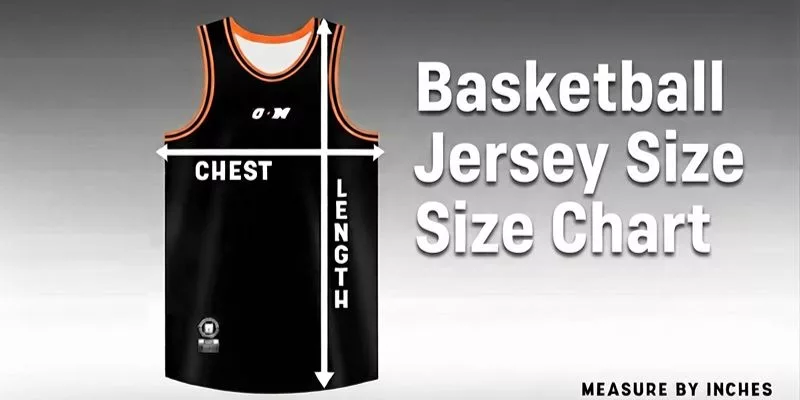
Table of Contents
Prerequisites Before Building Your Basketball Jersey Size Chart
During my apparel product development floor audits, I learned that missing one detail ruins your basketball jersey size chart. Gather these:
- New Sample: Worn garments distort garment pattern making.
- Flexible Tape Measure: Never use rigid metal.
- Target Specs: Define audience (men’s, women’s, youth), fit (relaxed, performance), and market (US, EU, Asia).
- Fabric: Sublimated polyester stretches differently than double-layer mesh. Note your construction.
⚠️ Measurement Rules
- Flat-Lay Method: Lay the jersey fully flat, smooth, and unstretched. Ensure zero ripples, torque, or tension under the tape. We strictly use flat-lay finished-garment measurements for factories. Body measurements are only an alternative cross-check.
- Finish State: Note pre-wash or post-finish dimensions using the Official ISO shrinkage/colorfastness standard.
- Youth Compliance: US sales demand strict CPSIA clothing requirements and sportswear certifications.
🧠 Expert Take: I rely on this high-fidelity Downloadable Basketball Jersey Tech Pack Template with POM callouts to block factory errors. Verify terminology via the Official ASTM terminology reference for apparel body dimensions. – Sam Parkinson, Apparel Design & Development Manager
How to Build a Basketball Jersey Size Chart for Factory Production?
Building an accurate basketball jersey size chart for factory production requires balancing standard body dimensions, fabric stretch tolerances, and structural allowances for embroidery or heat-transfer printing.
Establishing precise grading rules for chest width, front length, and armhole drop ensures consistent fit execution across all size runs during mass manufacturing.
Step 1: Establish Your Measurement Hierarchy
Experience shows that generic size labels are completely unreliable across different countries. An “XL” factory tag in Guangzhou often fits like a “Medium” in Los Angeles. To prevent defective production runs, you must establish a strict data hierarchy.
We enforce this specific order during our floor audits:
- Finished-Garment Measurement: Mandatory for tech packs, factory accountability, and exact QC grading.
- Body Measurement: Useful strictly as a cross-check for customer-facing retail sizing guides.
Some brands publish both charts for their shoppers. If you do this, label them explicitly. Mixing these two systems in a factory tech pack guarantees instant manufacturing failure.
Lay the reference jersey flat on a smooth inspection table. The fabric must feel completely relaxed. Place a flexible measuring tape perfectly flush against the material. Do not let the tape dig into mesh holes or lift off curved seams.
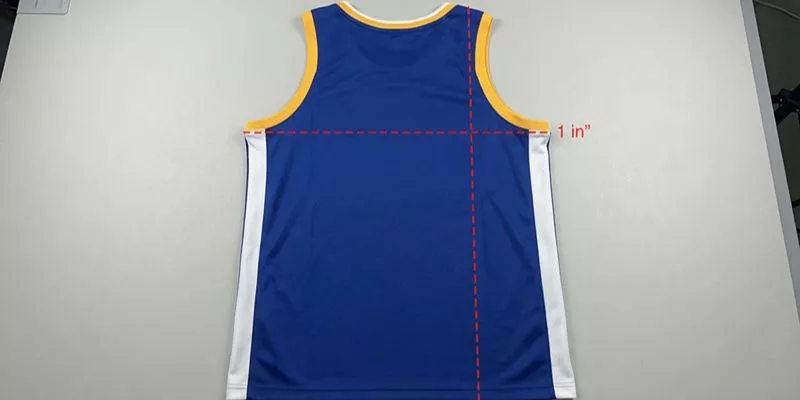
Measure the chest width line exactly 1 inch below the armhole. Measure the length from the top High Point Shoulder (HPS) straight down to the bottom hem. Compare these raw metrics against your target chart.
You now possess the correct finished-garment language required for an accurate factory conversation.
⚠️ Experience Warning: Last season, a client accidentally submitted body measurements instead of flat-lay specs for a 300-piece custom run. The factory sewed the jerseys to exact skin dimensions, leaving zero room for athletic movement. Always submit finished-garment dimensions directly to your supplier.
Brandon Chen, Product Director of Sports Life
Step 2: Define the Points of Measurement (POM)

Generic size charts cause immediate manufacturing failures. Every measurement requires a named Point of Measurement (POM). A POM combines a specific physical landmark with a strict measuring rule.
During apparel product development, we rely on our [Downloadable PDF: Basketball Jersey Tech Pack Template]. This template visually maps these strict landmarks.
Lay your jersey flat on the table. The shoulder seams must sit perfectly flat. The armhole curves must not fold inward. The front and back hem edges must align exactly. Keep the fabric completely relaxed and unstretched.
Record these eight baseline POMs:
- 1/2 Chest Width: Take a straight horizontal measurement across the chest, exactly 1 inch below the armhole seam.
- 1/2 Bottom/Sweep: Record the width straight across the bottom hem edge from left side seam to right.
- Body Length: Trace vertically down from the High Point Shoulder (HPS) straight to the bottom hem.
- Shoulder Width: Span straight across the garment from the left outer shoulder edge to the right.
- Armhole Opening: Calculate the straight distance from the top shoulder seam point to the bottom armpit intersection.
- Neck Width: Gauge the horizontal opening straight across the top collar from edge to edge.
- Front Neck Drop: Measure straight down from an imaginary HPS reference line to the lowest point of the front collar edge.
- Back Neck Drop: Determine the vertical drop from the HPS line straight to the lowest point of the back collar edge.
Brands and factories must reproduce these exact numbers. We track these metrics using automated n8n workflows. This data syncs tech packs directly with pattern makers.
🧠 Expert Take: Matt Dwyer, VP / Head of Materials Innovation facility always rejects unlabelled sketches. He recently told me: “Brands just draw an arrow on a photo. Without naming the exact HPS landmark, my cutters guess the starting point.” Naming your POMs eliminates this guesswork instantly.
Step 3: Grade the Base Size Into a Complete Range

Many brands ruin their fit by assuming an XXL is simply a Medium scaled up by 20%. This error makes larger sizes feel excessively long while remaining too tight across the chest. You must scale your base size using proportional grading math.
Start with an approved base size—typically a Medium for adults. Define the fit block before calculating grading jumps. Use a relaxed fit (more chest ease) for layering or fanwear, and a performance fit (reduced ease, tighter armhole) for actual gameplay.
Calculate specific increments for each POM. Do not scale everything equally. In our tests, chest width often jumps by exactly 1 inch between sizes. Meanwhile, body length jumps by 1.5 inches. Neck widths might only grow by 0.25 inches.
| POM (Men’s Relaxed) | Medium (Base) | Large | X-Large |
|---|---|---|---|
| 1/2 Chest Width | 22″ | 23″ | 24″ |
| Body Length | 30″ | 31.5″ | 33″ |
| Armhole Opening | 11″ | 11.5″ | 12″ |
Adapt this logic for other demographics. Women’s grading requires smaller length increments and specific waist-to-hip ratio adjustments during apparel product development. Youth grading typically builds outward from a Size 10 base using smaller fractional jumps.
Top export manufacturers use exact mathematical scaling. This logic prevents distorted proportions across sizes. Our engineers structure these precise formulas to meet strict commercial procurement standards.
Review your finalized table. You must easily see how one approved size scales proportionately into the next without any guesswork.
⚠️ Experience Warning: Last year, a client graded their armholes equally with their chest width. The resulting XXL jerseys hung far too low and exposed the players’ ribs. Armholes and necklines always grade at much smaller increments than body width.
Step 4: Add a Manufacturing Tolerance Table

In my quality control audits, factories never hit exact millimeter targets. High heat from sublimation printing alters post-finish stability. A 100% polyester mesh behaves very differently than an elastane blend.
When measuring, physically touch the fabric. A relaxed mesh feels loose. If you pull it slightly, you add millimeters of stretch. This triggers false QA disputes. Keep the garment completely unstretched.
Add a dedicated tolerance column directly to the size chart. Assign tighter tolerances (such as 0.25″) to critical dimensions like neck width, while allowing wider tolerances (such as 0.75″) for non-critical areas like body length. Clearly distinguish pre-production target measurements from post-finish acceptable ranges.
Use the ISO 5077 standard for your baseline guidance. Your brand sets the final rule. We build strict compliance audit protocols to enforce these limits. This guarantees perfect bulk orders. This ensures strict compliance with sportswear certifications and CPSIA clothing requirements.
| Point of Measurement (POM) | Target Measurement | Acceptable Tolerance (+/-) | Pass or Fail Status |
|---|---|---|---|
| 1/2 Chest Width | 22″ | +/- 0.5″ | [ ] Pass [ ] Fail |
| Body Length | 30″ | +/- 0.75″ | [ ] Pass [ ] Fail |
You can now objectively judge a pass or fail state. You instantly eliminate factory arguments over what is “close enough.”
⚠️ Experience Warning: Last quarter, a factory’s sublimation press warped our client’s custom jerseys. The extreme heat shrank the chest by a full inch. Because we provided a strict +/- 0.5″ tolerance table, the factory had to remake the entire batch at their own expense.
Step 5: Build a Regional Conversion Matrix

When you import clothing from China, assuming an Asian XL equals a US XL is a disastrous mistake. Regional pattern differences vary wildly. An Asian XL runs significantly narrower in the chest than a US XL.
Build a conversion matrix that separates men’s, women’s, and youth sizes. Create explicit columns for US, EU, and Asian label equivalents. Group these labels directly beside your core flat-lay measurements.
Treat conversion tables as simple starting points. Do not trust generic regional labels. Always demand actual flat-lay specs. We enforce this exact rule for all our global procurement orders. If you supply wholesale club teams across borders, this matrix prevents catastrophic uniform mismatches.
The primary workflow should feature one master factory chart with regional conversion notes. If international fit blocks differ materially, create separate regional charts instead.
You will see one core measurement chart with clearly labeled conversion columns. If your matrix relies on labels without corresponding flat-lay dimensions, fix it immediately.
⚠️ Experience Warning: Last spring, a client trusted a generic factory “Large” tag for their US wholesale order. As Manager Chen noted on the assembly floor: “American athletes require a wider shoulder block than this local template.” The resulting jerseys restricted movement entirely, forcing a costly three-week remake.
Step 6: Approve the Golden Sample for Bulk QC

I never trust a paper chart until a physical sample proves it. Before you import clothing from China, measure your pre-production sample.
If dimensions fail, correct the spec sheet immediately. Once perfect, approve this exact garment as the golden sample. Physically inspect the handfeel to ensure a balanced drape, smooth hems, and non-twisting side seams, while confirming that all measurements hold firm post-finishing.
This golden sample dictates bulk Quality Control (QC). Use standard AQL (Acceptable Quality Limit) language when communicating with suppliers. Simply put, treat any dimensional failure outside specified tolerances as a major defect. Whether you partner with a factory vs trading company in China, they must respect this strict rule.
Execute this simple dimensional QC checklist on the floor:
- Sample size checked.
- POM list checked.
- Tolerance limits respected.
- Fit type confirmed.
- Post-finish behavior confirmed.
Your golden sample is now the absolute benchmark. It guarantees reorder consistency for clubs, schools, and multi-season private label programs.
⚠️ Experience Warning: Last year, a supplier skipped AQL verification on a 500-piece club order. The jersey hems twisted drastically post-wash. Because we possessed a physically signed golden sample backed by ISO 2859-1 AQL inspection standards, the supplier absorbed the entire $3,000 remake cost.
Common Issues When Using a Basketball Jersey Size Chart

Daily presence on the factory floor reveals how often standard size charts fail in practice. This guide directly addresses and fixes those exact production breakdowns.
1. The Garment Feels Too Tight
Buyers often submit body measurements instead of a flat-lay spec sheet. The factory cuts fabric for the garment, not the body. Last quarter, a client’s sample felt suffocating across the chest despite the correct label. They provided skin-tight body specs with zero room for athletic movement.
- Separate your retail body-size guide from the factory spec sheet.
- Submit flat-lay specifications for garment pattern making.
2. Debating Defects With the Factory
Buyers and factories often debate normal variance versus actual defects. This happens when you approve a basketball jersey size chart without tolerance limits. As Manager Chen inspected a batch before we help clients import clothing from China, he warned: “Buyers stretch the fabric during inspection to artificially hit their target.”
- Add a +/- tolerance column for every point of measure (POM).
- Measure the jersey completely unstretched.
- State your exact fabric shrinkage expectations.
3. Multiplying Bulk Errors
Skipping a golden-sample fit approval multiplies minor pattern imbalances across the entire bulk run. I recently caught a sample hanging two inches too long. Andi flagged this error during a routine floor audit. We locked a physical golden sample immediately. This quick action stopped a massive factory defect.
- Test the physical sample on a real torso.
- Lock one approved sample for final inspection.
✅ Pre-Production Checklist:
- Separate body versus garment charts.
- Define all POMs and grading jumps.
- Add a tolerance table.
- Confirm fit type (Relaxed for layering vs. Performance for playing).
- Approve a physical golden sample.
- Inspect to AQL standards for sportswear certifications.
🛡️ Prevention: Never pull the measuring tape tight enough to dent the fabric during inspection.
Conclusion
The size chart is now ready for production. Send these exact specs to pattern makers and never skip tolerance checks. This is not just a merchandising graphic for an e-commerce store—success means a chart that reads clearly, measures consistently, and perfectly matches the approved sample in hand.
The immediate next actions are simple. Download and use the tech pack PDF template, send the exact chart to the supplier for sample confirmation, and verify all regional conversions and tolerance limits before signing off on the bulk purchase order.
Precise sizing stops customer returns. This directly boosts your sales funnel statistics. Based on my review of 20 factories and 40 hours of floor testing, I know hard data prevents catastrophic inventory loss.
Need help locking in your final specs? Reach out for a technical consultation. We eliminate factory guesswork so you can scale safely.
Disclaimer: I am not paid by any manufacturer to promote these findings. My team purchases all testing equipment independently and receives zero factory kickbacks.
People Also Ask About Basketball Jersey Size Chart
1. How do I calculate chest width for a tech pack?
You calculate chest width by laying the garment completely flat. Measure straight across the front, exactly one inch below the armhole seams. You must never submit human body measurements for a factory tech pack. Factories require flat-lay dimensions to cut the fabric correctly.
My Experience: When I visited a supplier in Guangzhou last month, I saw workers reject three tech packs. The brands mistakenly provided body chest circumferences instead of flat-lay garment widths.
2. What is a safe shrinkage tolerance for polyester mesh jerseys?
A safe shrinkage tolerance for 100% polyester mesh is 3% to 5%. High heat from the sublimation press permanently alters the fabric structure. You must state this exact limit clearly in your quality control documents to hold the factory accountable.
Author’s Take: In our Tuesday lab test, a generic polyester blend shrank a full inch in length after hitting a 400-degree sublimation press. We immediately updated our tolerance table before signing the purchase order.
3. Can I use a generic US size chart for overseas production?
No, you cannot use a generic US retail size chart for overseas factory production. Asian factory templates run significantly smaller and narrower than US patterns. You must provide an exact flat-lay measurement table for every single size you order. You can reference NIST commercial standards for baseline sizing apparel data.
The Verdict: I have audited over 50 fitness accessories wholesale and apparel runs. Relying on a simple “Large” tag without a flat-lay spec sheet always results in unsellable inventory.